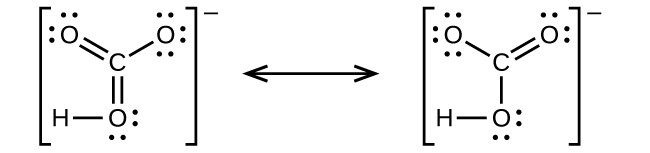
Hydrogen Carbonate Lewis Structure. Hydrogencarbonate is the carbon oxoanion resulting from the removal of a proton from carbonic acid. We assign lone pairs of electrons to their atoms.
Formal Charges and Resonance Chemistry I from courses.lumenlearning.com
It is the conjugate base of the hydrogen carbonate bicarbonate ion hco 3 which is the conjugate base of h. Carbon → 1s2 2s2 2p2. Now each cl atom has seven electrons and the br atom has seven electrons.
The Lewis Structure Of Ammonia, Nh3 , Would Be Three Hydrogen Atoms Bonded To A Nitrogen Atom In The Middle, With A Lone Pair Of Electrons On Top Of The Atom.
Now each cl atom has 6 unshared electrons and 2 bonding electrons, and the br atom has 4 unshared electrons and 6 bonding electrons. Experts are tested by chegg as specialists in their subject area. Carbon → 1s2 2s2 2p2.
Start Studying Chem 250 Lewis Structures.
If you look at the electronic configuration of the elements, you will see hydrogen has a lonely. After counting the valence electrons, we have a total of 9 [5 from nitrogen + 4(1 from each hydrogen)] = 9. What are the formal charges of each atom in these ions?
Ch 4, Nh 3, I 2.
Of electrons in the outer orbital. Put the least electronegative atom in the center. Make sure to show all nonbonding pairs of electrons and assign the correct charges to the right atoms in each structure.
It Has A Role As A Human Metabolite, A Saccharomyces Cerevisiae Metabolite, An Escherichia Coli Metabolite, A Mouse Metabolite And A Cofactor.
Draw lewis structures for the polyatomic ion “hydrogen carbonate” (bicarbonate) and acetic acid. Steps for writing lewis structures. Computational chemistry predicts that the left structure (which minimizes formal charge since all atoms have a formal charge of zero) contributes the greatest to the bonding in co 2 (~50%).
This Is The Reason Why Ammonia Acts As A Lewis Base, As It Can Donate Those Electrons.
Hydrogencarbonate) is an intermediate form in the deprotonation of carbonic acid. The other two structures contribute less to the bonding structure (~25% each). Oxygen → 1s2 2s2 2p4.