How To Find Resultant Velocity. And that's only part of the answer. Multiply the acceleration by the time the object is being accelerated.
How To Find Resultant Velocity And Direction SULRET from sulret.blogspot.com
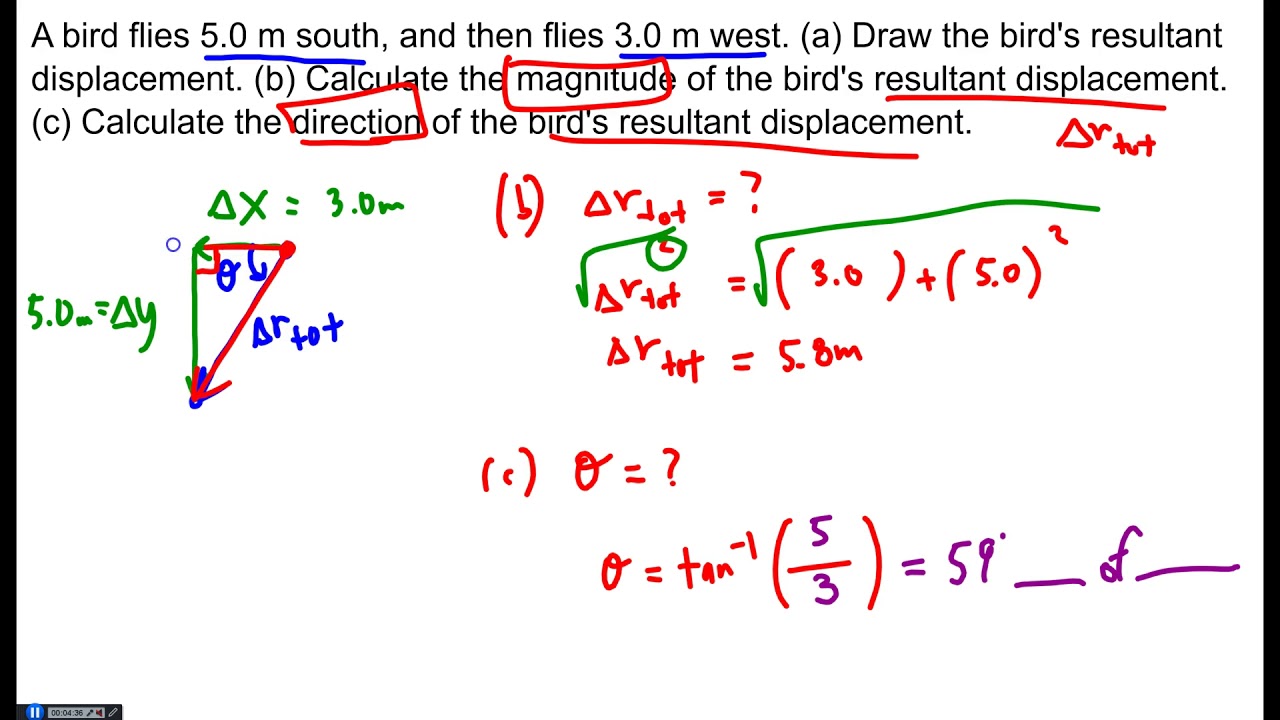
The whole answer in the textbook says 5 mi/h at an angle of ≈53.13° to the bank. But how do i find the angle to the bank? Resultant velocity for two velocity components calculator uses resultant_velocity = sqrt ((velocity component at u ^2)+(velocity component at v ^2)) to calculate the resultant velocity, the resultant velocity for two velocity components is known from kinematics flow while considering the velocity.
60 X 3 Minutes = 180 Seconds.
For example, if an object falls for 3 seconds, multiply 3 by 9.8 meters per second squared, which is the acceleration from gravity. View chapter purchase book vectors and matrices stephen andrilli, david hecker, in elementary linear algebra (fifth edition), 2016 Multiply the acceleration by the time the object is being accelerated.
R = √ [P 2 + Q 2 + 2Pqcosθ] Where:
When calculating the velocity of the object, follow these steps: The resultant velocity in this case is 29.4 meters per second. To find the magnitude and angle of a resultant force, we.
The Resultant Velocity Of An Object Is The Sum Of Its Individual Vector Velocities.
If 4 n and 9 n forces are acting perpendicular to an object. This column, we will calculate resultant velocity. To find the resultant force subtract the magnitude of the smaller force from the magnitude of the larger force.
The Formula For Calculating The Resultant Of Two Vectors Is:
According to math warehouse, the resultant vector is the vector that ‘results’ from adding two or more vectors together. Velocity (v) is a vector quantity that measures displacement (or change in position, δs) over the change in time (δt), represented by the equation v = δs/δt. Vm = sum sqrt (vxi^2+vyj^2) where vm is the resultant velocity magnitude.
As Given In The Problem,:
For example, if an object falls for 3 seconds, multiply 3 by 9.8 meters per second squared, which is the acceleration from gravity. Resultant force can be computed by the given formula: By the way, the information about the angle (pi/4) can be retrieved from the directions (east and north east) already and is thus redundant.